A discharged bed is not a free bed. The moment a patient walks out, your bed counter stays red until housekeeping clears it, inspects it, and nursing signs off. That gap, which can stretch from 30 minutes to over 3 hours in a busy ward, is where your occupancy rate quietly bleeds. The good news: this is fixable, and the fix starts with making bed turnaround time a measurable, owned metric in your hospital.
How to improve bed turnaround time: Notify housekeeping the moment a discharge order is raised, not after the patient leaves. Use a real-time bed cleaning status board visible to nursing and admissions simultaneously. Set shift-wise SLA targets (for example, 45 minutes for a general ward bed) and track average clean time by ward every day so delays are caught before they compound.
The Invisible Bottleneck
When a patient is discharged, three departments need to act in sequence: nursing closes the episode, housekeeping cleans the bed, and admissions allocates it to the next patient. In most hospitals, these three teams have no shared live view of what is happening. Nursing writes the discharge note. Housekeeping finds out through a phone call, a WhatsApp message, or a physical round. Admissions checks verbally whether a bed is ready.
In a 100-bed hospital running at 80% occupancy, a 2-hour average cleaning delay means roughly 8 to 10 beds are unavailable at any given moment, not because they are occupied, but because they have not been cleared yet. If your average revenue per bed per day is ₹3,000, those phantom-occupied beds cost you real money every day of the year. At 10 beds delayed for 3 hours each, that is 30 bed-hours lost daily. Scale that across a month and the revenue impact is significant, even before you account for the patients turned away or referred elsewhere.
The structural problem is that nobody formally owns the gap between "discharged" and "admitted". Without a shared system surfacing bed cleaning status to all three teams simultaneously, each department works on its own clock and the patient waiting in casualty pays the price.
Bed Cleaning Status: What Your System Should Actually Track
Most hospital software marks a bed as either occupied or vacant. Very few track the states in between, and those intermediate states are what actually drive real bed availability. A proper bed cleaning status workflow has six distinct stages, each with a clear owner.
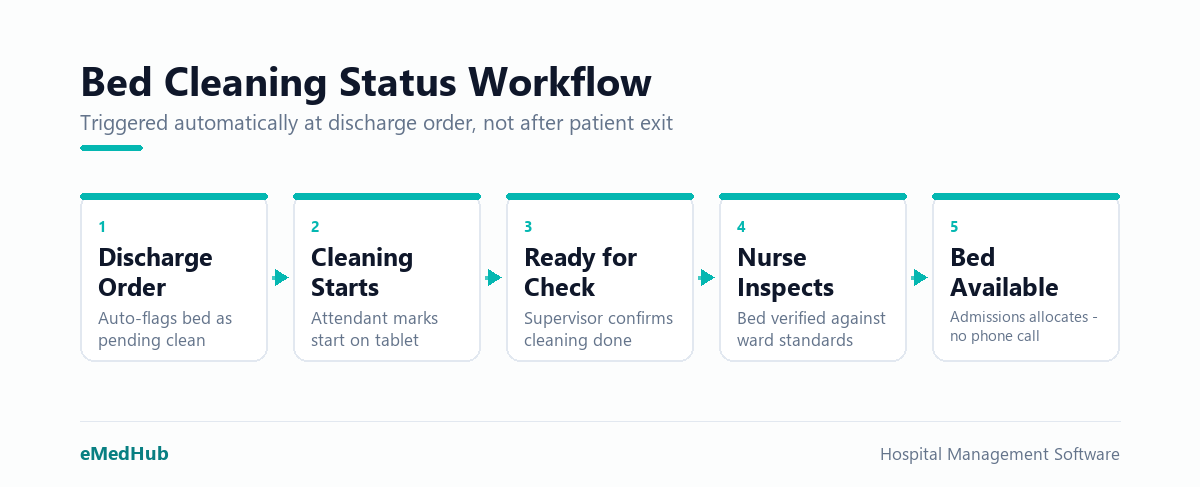
- Pending cleaning: triggered automatically when a discharge order is raised in the system, before the patient has even left.
- Cleaning in progress: the housekeeping attendant marks start on a mobile or ward tablet.
- Ready for inspection: the housekeeping supervisor marks completion.
- Inspection passed: the nurse confirms the bed meets standards and it moves to available.
- Available: admissions can now allocate the next patient without a single phone call.
- Maintenance hold: a separate flag for beds with defects such as a broken call bell, a faulty IV stand, or a mattress issue, with an engineering ticket attached so the bed is clearly separated from clean-pending beds on the admissions board.
Without this chain, admissions calls nursing, nursing calls housekeeping, and 20 minutes vanish in phone tag. That repeats for every discharge, on every shift, every day of the year.
Coordination: The Real Housekeeping Problem in Hospitals
Housekeeping in most Indian hospitals is either outsourced to a facility management company or staffed through a contractor. That arrangement creates a coordination gap. The hospital's nursing team and the contractor's supervisors work on different channels: some hospitals rely on WhatsApp groups, others use verbal ward rounds. Neither is auditable, and neither integrates with your admissions view.
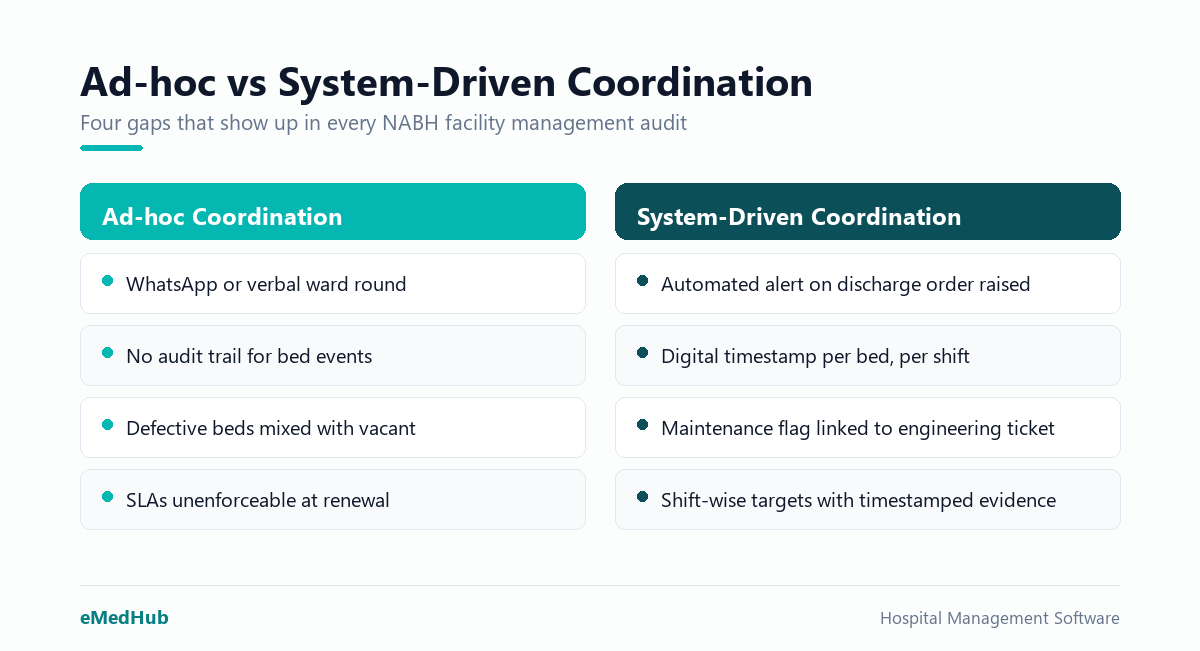
When a maintenance hold enters the picture, the problem compounds. A bed with a broken call bell cannot be admitted to, but it sits in the "vacant" column on your board and causes admissions staff to assign a patient who then cannot be placed. Effective housekeeping hospital coordination requires four things:
- A unified status board visible to nursing, admissions, and housekeeping supervisors at the same time.
- Automated alerts pushed to housekeeping the moment a discharge order is placed, not a manual phone call that depends on someone remembering.
- A maintenance flag linked to an engineering ticket, so defective beds are never confused with beds awaiting cleaning.
- Shift-wise SLA targets written into your facility management contract: for example, a general ward bed cleaned within 45 minutes and an ICU or isolation room within 60 minutes, with digital timestamps as evidence at contract renewal.
If your hospital is preparing for NABH accreditation, documented SLAs and time-stamped workflow data are directly relevant to facility management standards. The audit question is not whether you have a process; it is whether you can prove the process is followed.
Measuring Bed Turnaround Time: The Numbers That Matter
You cannot improve what you do not measure. Bed turnaround time is the elapsed time between a patient vacating a bed and the next patient being admitted to that same bed. It has two distinct components: cleaning time (housekeeping's responsibility) and allocation time (admissions' responsibility). Track them separately or you will misdiagnose the bottleneck.
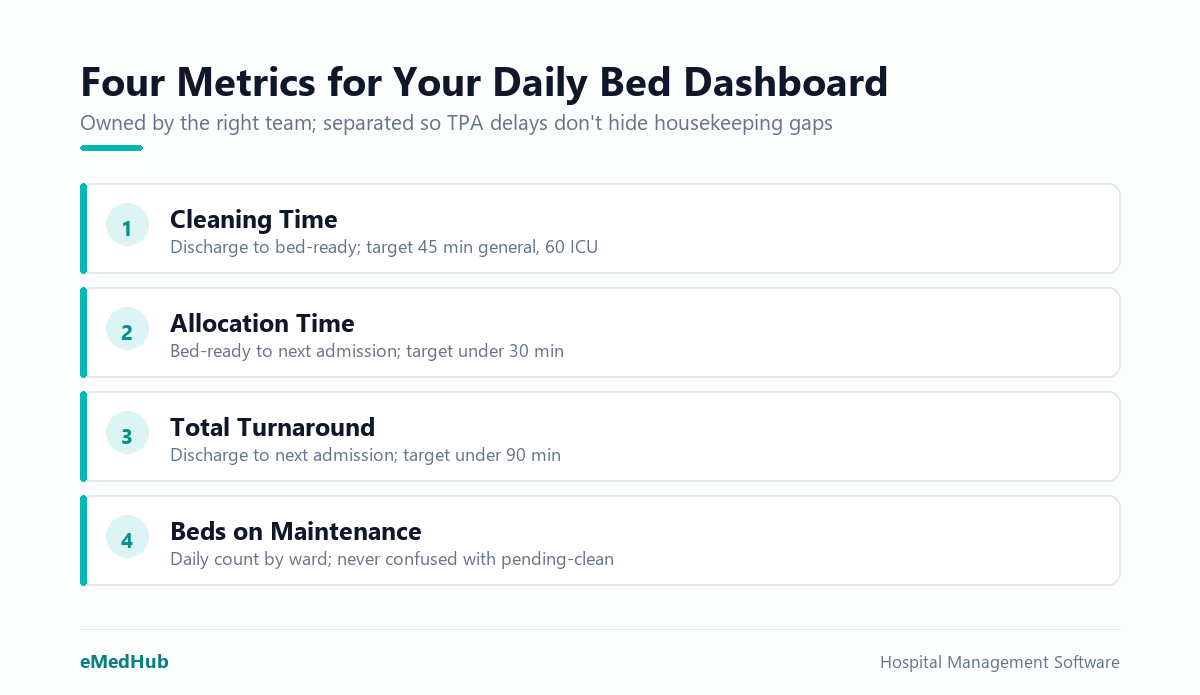
If cleaning time is consistently under 45 minutes but allocation time is 3 hours, the problem is not housekeeping. It is the admissions process: a pending pre-authorization for a TPA or Ayushman Bharat case, a CGHS or ESI referral letter being processed, or a doctor's admission order that arrives late. The table below shows the four metrics your daily dashboard should display.
| Metric | What it measures | Owner | Typical target |
|---|---|---|---|
| Cleaning time | Discharge to bed-ready | Housekeeping | 45 min (general), 60 min (ICU) |
| Allocation time | Bed-ready to next admission | Admissions | Under 30 min |
| Total turnaround time | Discharge to next admission | Both teams | Under 90 min |
| Beds on maintenance hold | Defective beds as % of total capacity | Engineering | Under 3% |
Pull these four numbers by ward every morning. Patterns surface quickly. A ward with consistently high cleaning times points to a staffing or workload problem. A ward with high allocation times points to an upstream process failure in admissions or clinical documentation. Fixing the right bottleneck is only possible when the data separates the two.
How eMedHub Handles It
eMedHub's inpatient management module includes a real-time bed status board that tracks all six states: occupied, pending cleaning, cleaning in progress, ready for inspection, available, and maintenance hold. When a discharge order is raised, housekeeping supervisors receive an automatic alert on their mobile view. Attendants update status as they work. Nursing confirms inspection with a single tap. Admissions sees live availability without calling the ward.
Ward-wise and shift-wise turnaround reports are built in. You can pull cleaning SLA performance for any date range in under a minute and export it for NABH documentation or contractor review. The maintenance hold workflow links directly to your engineering team's task queue so defective beds are tracked through to resolution, not forgotten.
Book a demo to see the bed status board live.
Frequently asked questions
What is a good bed turnaround time in a hospital?
A practical target for a general ward bed is under 90 minutes from patient discharge to the next patient admitted. This breaks down as roughly 45 minutes for cleaning and inspection, and under 30 minutes for admissions allocation. ICU and isolation rooms may need up to 60 minutes for cleaning given the more thorough protocols required.
How do I track bed cleaning status in real time?
Use a bed management system that supports multiple status states beyond simply occupied or vacant. You need at minimum: pending cleaning, cleaning in progress, ready for inspection, available, and maintenance hold. Housekeeping staff should be able to update their status from a mobile or ward tablet, and nursing and admissions must see the same live board simultaneously.
Why is housekeeping coordination so difficult in Indian hospitals?
Most Indian hospitals outsource housekeeping to a facility management contractor, which creates a communication gap between the hospital's nursing and admissions teams and the contractor's supervisors. Without a shared digital system, teams rely on phone calls and WhatsApp messages, which are neither auditable nor integrated with your bed availability view, leading to delays and confusion.
Does bed turnaround time affect NABH accreditation?
Yes, indirectly but significantly. NABH facility management standards require hospitals to demonstrate documented processes for bed management and housekeeping. Time-stamped records of cleaning SLAs, maintenance hold workflows, and discharge-to-admission intervals serve as audit evidence. Hospitals with a digital bed status system are in a considerably stronger position during NABH assessments.
How much revenue does a delayed bed turnaround actually cost?
The loss depends on your bed rate and delay frequency. As an example: a 100-bed hospital with a ₹3,000 average revenue per bed per day, running 8 beds delayed by 3 hours each on average, loses roughly 30 bed-hours daily. Across a month that is 900 bed-hours, equivalent to approximately 37 full bed-days of unearned revenue, a material figure at any bed rate.