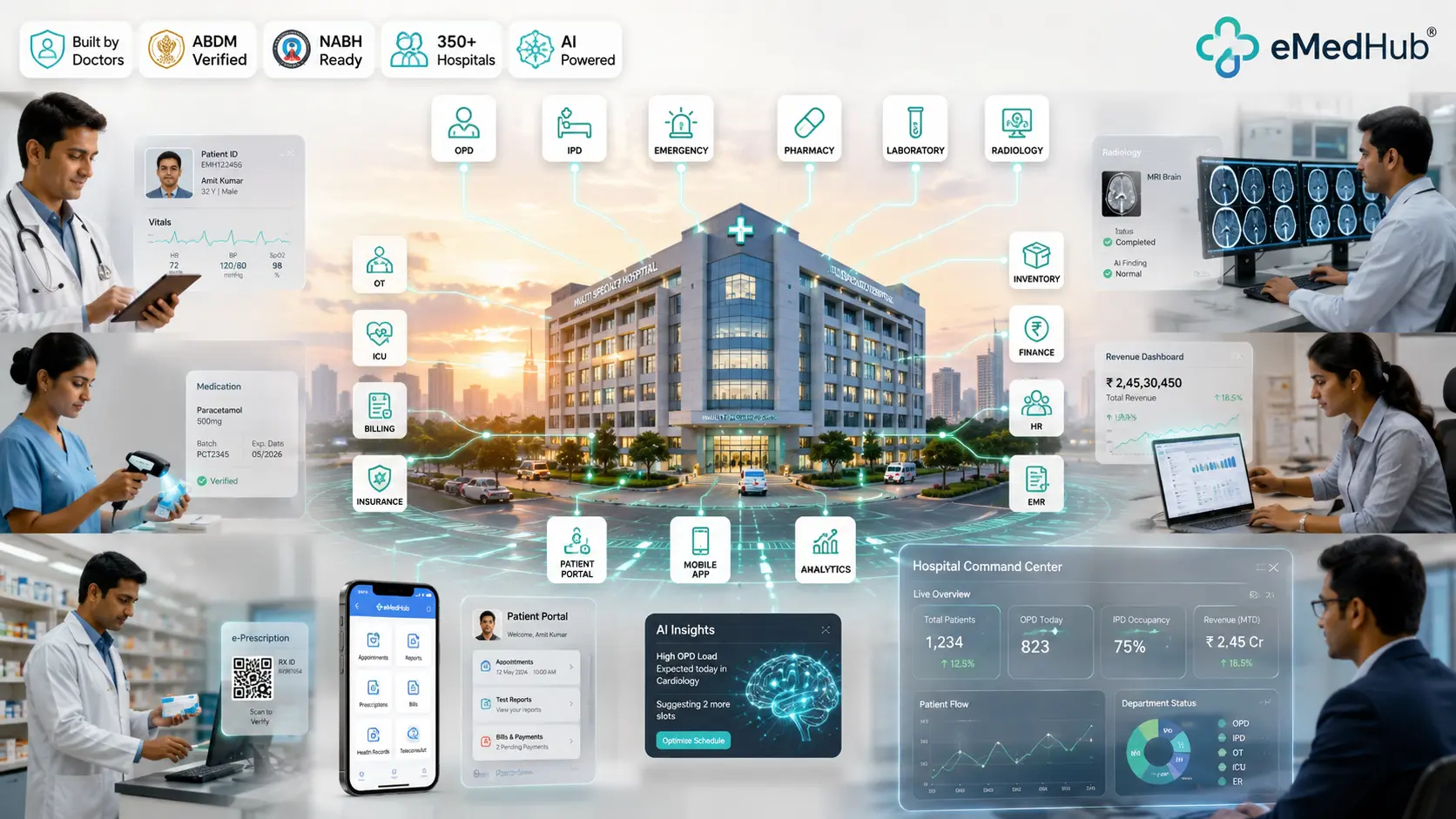
Quick answer: The best hospital management software (HMS) in India is the one that is ABDM-ready, NABH-aligned, cloud-based, modular across OP/IP/pharmacy/lab/billing, and priced to your bed size — not the one with the longest feature list. For most Indian hospitals in 2026 that means a cloud Hospital Information System (HIS) that captures every charge automatically, integrates ABHA and TPA/insurance, secures data under the DPDP Act, and can go live in weeks. This guide shows you exactly how to evaluate and choose one.
Choosing hospital management software is one of the highest-stakes operational decisions a hospital makes. Get it right and you recover leaked revenue, pass NABH, meet ABDM mandates, and give clinicians time back for patients. Get it wrong and you inherit years of workarounds, data lock-in, and frustrated staff. This is a vendor-neutral decision framework — useful whether or not you ever talk to us.
What is hospital management software?
Hospital management software (HMS), also called a Hospital Information System (HIS) or hospital ERP, is an integrated platform that runs a hospital's clinical, administrative, and financial operations on a single shared patient record — from registration and appointments through OPD/IPD, diagnostics, pharmacy, and billing to discharge and reporting.
In plain terms: instead of a dozen disconnected registers, Excel sheets, and standalone tools, one system carries the patient — and their charges, orders, and records — across every department. Indian HMS have evolved from billing-only, on-premise tools in the 2000s to modular departmental systems in the 2010s, and now to cloud-based, ABDM-ready, AI-assisted platforms governed by the DPDP Act 2023.
HMS vs HIS vs EMR vs EHR vs LIS vs RIS: what's the difference?
Vendors blur these terms. Here is what each actually means so you buy the right thing.
| Term | What it is | Scope |
|---|---|---|
| HMS / HIS | Runs clinical + admin + finance operations | Whole hospital |
| Hospital ERP | HMS plus deep finance, HR, supply chain | Whole enterprise |
| EMR | Digital medical chart within one facility | Clinical, single site |
| EHR | Longitudinal record shared across facilities | Clinical, cross-site |
| LIS | Laboratory Information System (order → result → report) | Lab |
| RIS / PACS | Radiology workflow / medical image storage | Imaging |
| ABDM / ABHA | India's national digital health rails / patient health ID | National |
| FHIR / HL7 | Data-exchange standards that let systems talk | Interoperability |
Rule of thumb: you buy an HMS/HIS. It should contain a strong EMR/EHR, include or integrate LIS/RIS, and speak ABDM + FHIR + ICD natively. Explore the core Hospital Information System and EHR to see how they fit together.
Why do hospitals need hospital management software?
Hospitals need an HMS to protect revenue, run efficiently, stay compliant with ABDM and NABH, automate repetitive work, secure patient data, and scale without adding chaos.
- Revenue: auto charge capture, discount governance, and TPA reconciliation recover the 5–15% that leaks from manual billing.
- Efficiency: one patient record ends re-registration and inter-department phone calls; queues and discharges speed up.
- Compliance: NABH needs audit trails; ABDM needs ABHA and FHIR; DPDP needs consent and access control.
- Automation: reminders, reorder alerts, day-end reconciliation, and report delivery happen without staff effort.
- Security: encryption, role-based access, and audit logs protect the most sensitive data there is.
- Growth: a multi-branch platform lets you add units, specialties, and beds without re-platforming.
How hospitals lose revenue — and how software fixes it
Billing leakage typically runs 5–15% of revenue in partially digitised hospitals — the single biggest ROI lever of a good HMS. Here are the most common leaks and the control that closes each.
| How revenue is lost | How HMS fixes it |
|---|---|
| Procedure done but never billed | Auto charge capture at point of care |
| Consumables/implants used but unrecorded | Consumable-to-service mapping |
| Unauthorised discounts at the counter | Maker-checker discount approval |
| Medicines dispensed without billing | Prescription-to-bill + IP drug chart |
| Lab/radiology done but not billed | Order → result → bill lock |
| TPA claims aged into write-offs | Credit-ageing worklist + escalation |
| TPA short-payments absorbed silently | Approved-vs-billed-vs-settled reconciliation |
| Cash counter shortfalls found only at audit | Daily day-end reconciliation |
| Bills edited/cancelled after payment | Approval-gated reverts + audit trail |
| Expired pharmacy stock written off | Batch/expiry tracking + alerts |
| No-shows waste paid-for slots | WhatsApp/SMS reminders + confirmations |
| Revenue invisible across branches | Consolidated multi-branch reporting |
Want to quantify your own leakage? Use the free Hospital ROI Calculator.
What features should the best hospital management software have?
A complete HMS spans front-office, clinical, diagnostics, pharmacy/inventory, finance, HR, and patient engagement — all on one record. You rarely need every module on day one; you need a platform that has them when you grow.
Front office & billing
- Registration — one identity, ABHA-linked, QR/face check-in, duplicate prevention.
- Appointments & queue — online booking, multi-doctor slots, token/call-patient.
- Billing — OP single-screen + IP accrual, GST, packages, estimates, auto charge capture, maker-checker discounts, day-end.
- Insurance & TPA — pre-auth, claim submission, credit-ageing, bulk settlement.
Clinical
- OPD & IPD — consultation, e-prescription, admission/ADT, bed & ward management, MLC.
- Emergency — triage, ER billing, ER→IP/OP conversion.
- EMR/EHR — configurable notes, ICD, AI-assisted documentation.
- Nursing, OT & ICU — nursing assessments, OT scheduling with IOL/consumable inventory, ICU vitals/ventilation/I-O charts.
Diagnostics, pharmacy & back office
- Laboratory (LIS) — SID barcoding, analyser integration, culture & sensitivity, approval + e-sign, outsourcing.
- Radiology (RIS) — worklist, structured reporting, critical alerts.
- Pharmacy & inventory — dispensing, batch/expiry, LASA safety, purchase/GRN.
- Finance, HR/payroll, assets — day-end, accounting/Tally export, shifts & doctor pay, equipment maintenance.
Engagement, intelligence & platform
- Patient portal, mobile apps, teleconsultation, WhatsApp/SMS.
- Analytics & dashboards — realisation, occupancy, TAT, receivables.
- AI, digital signature, barcode/QR, biometric, and open APIs (ABDM, payment gateways, analysers).
Which hospital management software is right for my hospital?
Match the software to your size and specialty. Small hospitals need a lean, fast-go-live cloud core; large and corporate hospitals need multi-branch depth and analytics; specialty hospitals need specialty-fit modules on top of the core.
| Hospital | Priorities |
|---|---|
| Clinic / 20–50 bed | Fast go-live, low cost, cloud, ABHA, OP+billing+pharmacy |
| 100–300 bed | Revenue controls, IP/OT/ICU, TPA depth, NABH audit trails |
| 500+ bed / chain | Multi-branch, BI, HR/payroll, integrations, consolidated reporting |
| Eye hospital | Sub-specialty EMR, IOL inventory, optical shop — see eye hospital software |
| IVF centre | Full ART cycle, embryology, cryobank — see IVF software |
| Diagnostic centre | LIS, home collection, B2B — see diagnostic lab software |
| Multispecialty | Every department on one platform — see multispecialty HMS |
ABDM, NABH and DPDP: the compliance baseline
In 2026, three things are non-negotiable for Indian hospital software:
- ABDM / ABHA: your HMS must create and link ABHA numbers and exchange FHIR-based records through the consent manager. ABDM is shifting from optional to mandatory for empanelment under public schemes.
- NABH: accreditation requires audit trails, documented processes, and quality indicators — an HMS makes these routine. Check your NABH readiness free.
- DPDP Act 2023: patient data needs consent, encryption, role-based access, and breach readiness — verify these are built in, not bolted on.
eMedHub is ABDM-verified (through its parent, Tecnospice Technologies) and NABH-ready, used across 350+ hospitals and 4,000+ doctors in India.
How much does hospital management software cost in India?
Pricing depends on deployment and scale, not a single sticker price. The realistic components are:
- Deployment: cloud (subscription, per bed/user/month, low upfront) vs on-premise (higher upfront + server + AMC) vs hybrid.
- One-time: implementation, data migration, training.
- Recurring: subscription or AMC, support, updates.
- Hidden costs to ask about: per-user charges, module add-ons, integration fees, customisation, data-export/exit terms.
Judge cost against total cost of ownership and ROI, not licence price alone — recovering even a few percent of billing leakage usually outweighs the subscription. See transparent pricing.
A quick buying checklist
Before you shortlist, confirm the software:
- Is cloud-based with data residency in India.
- Creates and links ABHA and exchanges FHIR records (ABDM-ready).
- Is NABH-aligned with full audit trails.
- Auto-captures charges across every department.
- Has maker-checker discount control and day-end reconciliation.
- Handles OP, IP, pharmacy, lab, and TPA natively.
- Supports your specialty (eye, IVF, diagnostics, etc.).
- Is multi-branch if you plan to grow.
- Offers role-based access, encryption, and backups (DPDP-ready).
- Guarantees your data is exportable — no lock-in.
- Delivers reports on WhatsApp/SMS and a patient portal.
- Can go live in weeks with training and migration included.
Why hospitals choose eMedHub
eMedHub is a cloud HIMS & EHR built for Indian hospitals: auto charge capture and maker-checker billing to plug revenue leakage, native ABDM/ABHA and NABH-readiness, deep TPA and credit-settlement, a full LIS and pharmacy with batch/expiry control, specialty solutions for eye and IVF, and multi-branch operations on one platform — with typical go-live in weeks. It is used by 350+ hospitals and 4,000+ doctors across India and is ABDM-verified through Tecnospice Technologies.
Frequently asked questions
What is the best hospital management software in India?
The best HMS is the one that fits your size and specialty while being ABDM-ready, NABH-aligned, cloud-based, and strong on billing and revenue controls. For most Indian hospitals that means a modular cloud HIS covering OP/IP/pharmacy/lab/billing with native ABHA and TPA — evaluate shortlisted vendors against a checklist rather than a feature-count.
What is the difference between HMS, HIS and EMR?
HMS and HIS mean the same thing — the whole system that runs a hospital. An EMR is the digital clinical record inside it. You buy an HMS/HIS that contains a strong EMR/EHR.
Is cloud or on-premise hospital software better?
Cloud suits most hospitals — lower upfront cost, no server room, automatic updates, and data residency in India. On-premise gives maximum local control but higher cost and maintenance. Choose based on IT capacity, budget, and data-governance needs.
Is the software ABDM and ABHA ready?
It must be. In 2026 your HMS should create/link ABHA numbers and exchange FHIR records via the consent manager. eMedHub is ABDM-verified through Tecnospice Technologies.
How long does implementation take?
A well-run cloud implementation — data migration, configuration, training, and go-live — typically takes a few weeks for small and mid-size hospitals, and longer for large multi-department hospitals.
How does hospital software increase revenue?
By eliminating billing leakage: auto charge capture, discount control, prescription-to-bill, order-to-bill locks, TPA reconciliation, and day-end closing recover the 5–15% that leaks from manual billing.
Can it handle multi-branch hospital chains?
Yes — a good HMS is multi-branch with per-branch data isolation and consolidated group reporting, so you add units without re-platforming.
Ready to choose the right HMS? Book a free demo, or calculate your ROI to see what the right software could recover for your hospital.