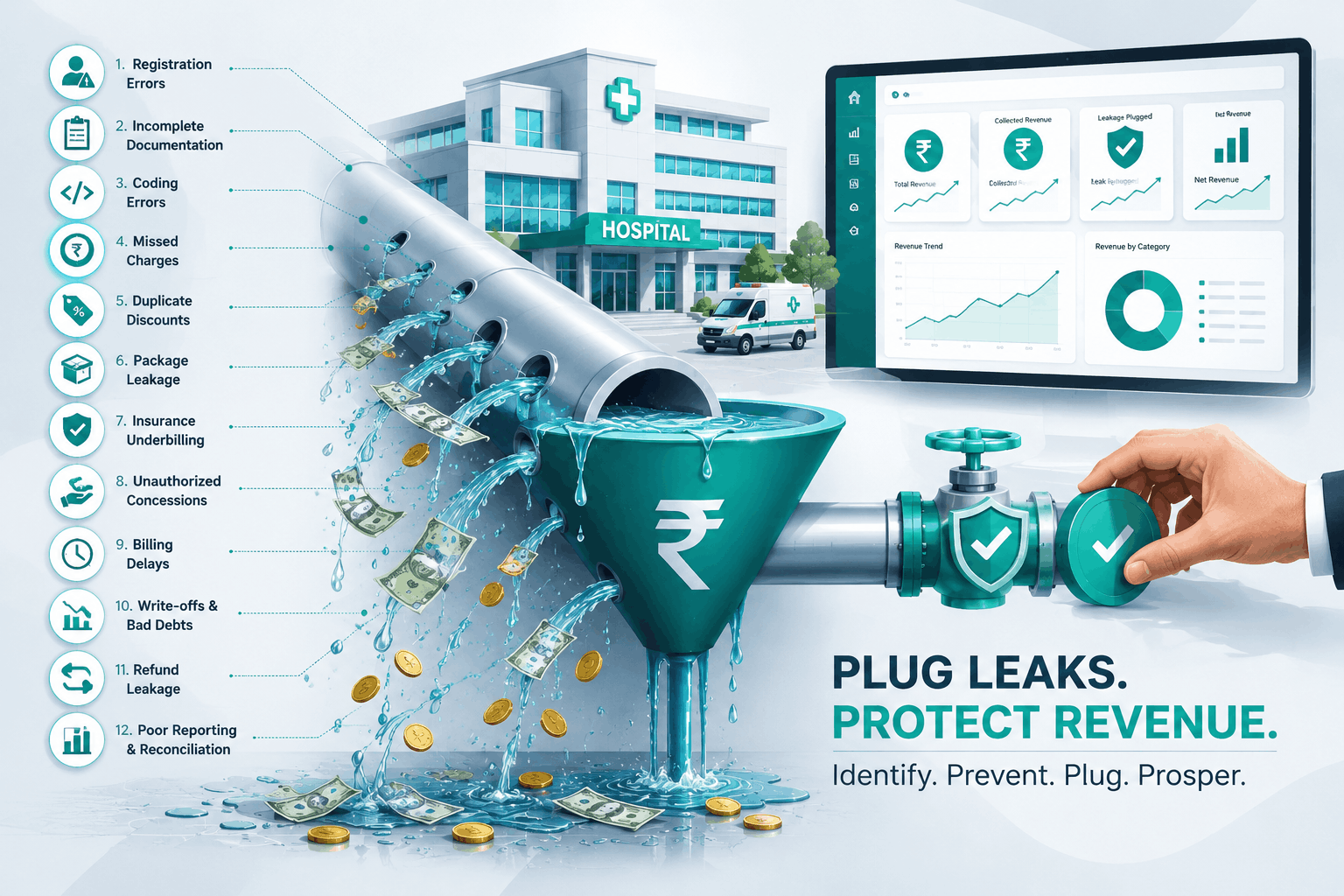
For most Indian hospitals, the biggest revenue problem is not pricing or patient volume — it is hospital billing leakage: revenue that was legitimately earned but never reaches the bank. Care is delivered, resources are consumed, and staff work hard, yet a measurable slice of income quietly disappears. Because each instance is small — a missed consumable here, an unbilled test there — leakage rarely triggers an alarm. It simply erodes the margin, month after month.
Industry estimates put revenue leakage in hospitals at 5–15% of total revenue, with paper-based and partially digitised hospitals at the higher end. For a 200-bed hospital earning ₹60 crore a year, even an 8% leak is nearly ₹5 crore lost annually — money already earned through care delivered. The good news: leakage is a systems problem, and systems can be fixed. This guide maps the 12 exact points where revenue escapes an Indian hospital, and the control that plugs each — the itemised detail most vendors skip.
What is billing leakage?
Billing leakage is the loss of earned revenue that happens when a service is delivered but never billed, is billed for less than the correct amount, or is billed but never collected. It is different from fraud (which is deliberate) and from claim denials (where a payer rejects a submitted claim). Billing leakage is almost always accidental — a by-product of manual processes, disconnected departments, and workflows that depend on a person remembering to add a charge.
That is exactly why it is invisible on standard reports. Unlike a denied claim, a leaked charge leaves no trace to investigate, because the service was never recorded as billable in the first place. A hospital can show healthy occupancy and a growing patient count while its realisation per patient quietly falls. This is also why leakage is best solved inside the Hospital Information System — at the point where charges are captured — rather than chased afterward.
The 12 hidden sources of billing leakage
In a typical multi-specialty hospital, revenue escapes from a predictable set of points across the patient journey. Here are the twelve, each with the control that closes it:
- Missed charge capture. A service is performed but never entered because staff rely on memory or paper slips. Fix: auto-capture at the point of care.
- Uncaptured consumables and implants. High-value items used in wards and theatres go unrecorded against the patient. Fix: consumable-to-service mapping.
- Unauthorised or excessive discounts. Staff waive charges with no ceiling or audit trail. Fix: a maker-checker discount workflow.
- Pharmacy dispensing without billing. Medicines leave the counter on a verbal or IP request that never becomes a charge. Fix: prescription-to-bill and IP drug-chart posting.
- Uncaptured diagnostics. Lab, radiology, and procedure orders are completed but never linked to a bill. Fix: an order → result → bill flow.
- Credit bills never followed up. Corporate, TPA, and IP dues age quietly into write-offs. Fix: credit-ageing reports that get worked.
- Insurance and TPA short-payments. Payers deduct quietly and nobody reconciles approved-vs-billed-vs-settled. Fix: settlement and disallowance tracking.
- Cash counter gaps. Manual day-end closing hides shortfalls between services rendered and cash collected. Fix: structured day-end reconciliation.
- Untracked bill edits and cancellations. Bills are altered after the fact with no approval or record. Fix: approval-gated reverts with an audit trail.
- Expired and pilfered pharmacy stock. Inventory is written off because expiry and batch movement are not tracked. Fix: batch/expiry tracking with alerts.
- Charge-master drift. Prices and service codes fall out of date, so services bill at old or zero rates — a common source of silent billing errors. Fix: a single, owned charge master.
- Referring-doctor share disputes and package gaps. Manual commission maths and inconsistent surgical packages mean add-ons never get billed. Fix: automated revenue-share and structured package/estimate billing.
- Uncollected advances and safety deposits. Deposits are taken informally and never adjusted against the final bill. Fix: deposit capture with adjustment and refund tracking.
Charge capture: the biggest single leak
If you fix only one thing, fix charge capture. The largest source of billing leakage is the human step between doing something and billing for it. Remove that step. When every chargeable service, room and procedure lives in a central charge master with a fixed price, and the act of ordering or performing it automatically posts a line item to the patient's bill, staff no longer have to remember to bill — the system does it for them. Tying dispensing and diagnostics to the same flow means a medicine cannot leave the pharmacy, and a report cannot be released, around the charge. This one change eliminates the majority of missed-charge and consumable leakage — and most everyday billing errors along with it.
Discounts: turning invisible losses into controlled decisions
Discretionary discounts are a major and often overlooked leakage channel. Without controls, a front-desk or billing user can waive charges with no ceiling and no record. A maker-checker workflow fixes this: any discount above a defined threshold is requested by one user and approved by an authorised user before it is applied. Every concession then carries a reason, an approver, and a timestamp. This converts discounting from an invisible loss into an auditable decision — and hospitals typically see total discounts given fall within the first month, simply because every waiver is now visible.
Day-end reconciliation: catch it the same day
Leakage that is caught the same day is recoverable; leakage found months later, at the annual audit, is not. A disciplined day-end process reconciles every cash counter's collections, refunds, and cancellations against the services rendered that day, so any mismatch is flagged immediately while the transaction is still fresh and correctable. Daily reconciliation turns billing leakage from an annual surprise into a routine, self-correcting control — and it pairs naturally with credit-ageing reviews so that billed-but-uncollected revenue (corporate, TPA and insurance dues) is worked before it lapses.
How software fixes hospital billing leakage
The controls above are only as good as the system they run on. Rather than bolting billing on as an afterthought, eMedHub's Hospital Information System wires charge capture into every clinical and operational workflow. A central charge master and auto-billing engine post charges the moment a service is ordered across OPD, IPD, pharmacy, laboratory, radiology and the operation theatre — so the care ordered and the care billed are always identical. Discounts pass through a maker-checker approval; bill edits and cancellations run through approval-gated reverts with a full audit trail; pharmacy dispensing links to billing with batch and expiry control; and TPA, credit-settlement and structured day-end reconciliation close the collection loop.
For hospital groups, the same controls run across every unit on one platform — see how the multispecialty hospital management software unifies billing, pharmacy, lab and TPA across departments and branches. Hospitals moving from manual or fragmented billing to eMedHub routinely report significantly faster billing, a sharp drop in billing errors, and the recovery of revenue that was previously leaking unnoticed.
Frequently asked questions
What causes hospital billing leakage?
Hospital billing leakage is caused by services being delivered but never billed, billed for less than the correct amount, or billed but never collected — through missed charge capture, uncaptured consumables, unauthorised discounts, pharmacy and diagnostics that skip billing, uncollected credit and TPA dues, and cash-counter gaps. It is accidental, stemming from manual processes and disconnected departments.
How much revenue do hospitals lose to billing leakage?
Most hospitals lose 5–15% of total revenue to billing leakage, with paper-based facilities at the higher end. For a 200-bed hospital earning ₹60 crore a year, even 8% is close to ₹5 crore annually.
Can hospital software stop billing leakage?
Yes. A Hospital Information System that auto-captures charges, controls discounts with maker-checker approval, links orders to bills, and reconciles collections at day-end removes the manual steps where revenue escapes — far more reliably than after-the-fact audits, which can only detect losses that have already happened.
Ready to see where your revenue is leaking? Book a free demo and our team will show you how eMedHub captures every charge, controls every discount, and reconciles every collection — so the revenue you earn is the revenue you keep.