Most hospitals in India treat every patient as a new transaction. A patient visits, pays, and leaves. Six months later, the front desk often registers them almost from scratch. A hospital membership program changes that: it converts the one-time visitor into a committed member who pays upfront and keeps coming back.
How do hospital membership programs work? A hospital membership program works by charging an upfront annual or monthly fee in exchange for a defined bundle of benefits: discounted consultations, waived registration charges, priority scheduling, and reduced pharmacy or diagnostic rates. The hospital bills on enrollment and auto-renews the subscription, creating predictable recurring revenue while deepening patient loyalty.
Why Memberships Work for Indian Hospitals
Ask the finance head at any well-run private hospital in a tier-2 city what share of outpatient revenue comes from repeat patients. You will usually hear 40 to 60 per cent. Those patients are already loyal. A membership formalises that loyalty and monetises it before the next visit even happens.
In a country where patients largely self-pay and TPA or CGHS reimbursements can take weeks to settle, a pool of 500 active members paying ₹2,000 a year generates ₹10 lakh in upfront cash. That working capital arrives before a single consultation happens. It also reduces price sensitivity: a patient who has paid ₹3,000 for an annual plan does not comparison-shop for a cheaper consultation nearby because they have already committed.
Seasonal footfall dips, common after major festivals or monsoon months, hit walk-in revenue hard. Membership revenue does not dip with footfall. That counter-cyclical stability is exactly what hospital finance heads need on their P&L.
Designing Your Hospital Membership Program Tiers
Not every patient needs the same package. A young working adult wants quick consultations and lab discounts. A senior citizen wants chronic-disease follow-up, home sample collection, and priority access. Design two or three tiers to match these profiles and price them honestly.
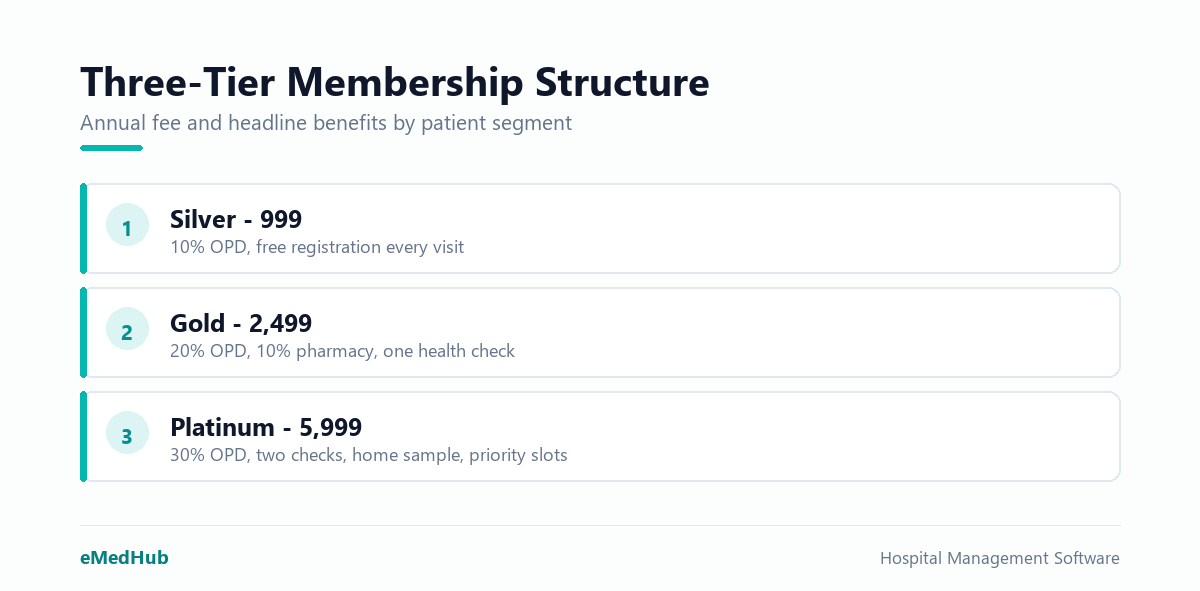
| Tier | Annual Fee | Key Benefits | Target Segment |
|---|---|---|---|
| Silver | ₹999 | 10% OPD discount, free registration on every visit | Young adults, working professionals |
| Gold | ₹2,499 | 20% OPD, 10% pharmacy, one free basic health check | Families, mid-income households |
| Platinum | ₹5,999 | 30% OPD, 15% pharmacy, two health checks, priority slots, home sample collection | Seniors, chronic-disease patients |
Keep the benefit arithmetic honest. If your standard consultation is ₹300 and Silver offers 10% off, a patient saves ₹30 per visit; four visits plus four waived ₹50 registration charges saves ₹320 on a ₹999 card. Add one anchor benefit, say a free ₹600 blood panel, and the value becomes immediately tangible. Avoid pharmacy discounts above your actual margin: a tiered cap (10% on generics, 5% on branded) protects margins while still feeling meaningful to the patient.
Billing and Renewals: Where Most Programs Fail
The tier design is usually fine. The billing workflow is not. Front-desk staff track renewal dates in a spreadsheet, forget to send reminders, and memberships lapse without anyone noticing until the patient arrives expecting a discount they no longer have.
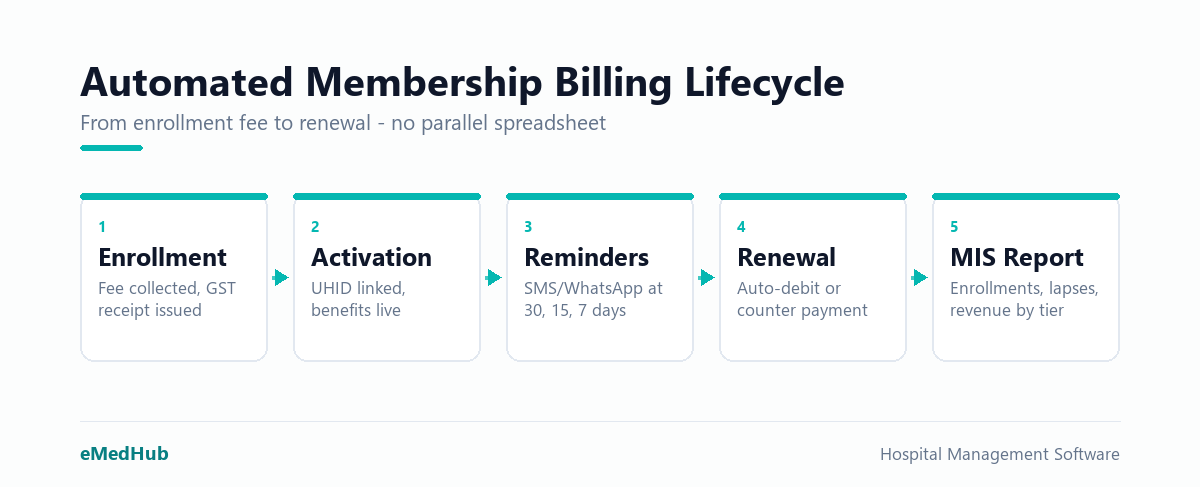
A proper billing module handles the full lifecycle automatically:
- Collects the enrollment fee and issues a GST-compliant receipt (health memberships attract GST as a taxable service; confirm the SAC code with your CA before launch)
- Sets the renewal date and sends SMS or WhatsApp reminders at 30, 15, and 7 days before expiry
- Supports auto-debit via a stored UPI mandate or card-on-file for patients who opt in
- Flags expired memberships at point of registration so the front desk does not apply a discount on a lapsed card
- Generates a monthly MIS report showing new enrollments, renewals, lapses, and net revenue by tier
Without this infrastructure, a health membership scheme becomes an administrative burden rather than a revenue stream. The right hospital information system embeds membership billing directly into patient registration so there is no parallel spreadsheet to maintain.
Benefits That Drive Enrollment and Loyalty in Healthcare
Design benefits around what patients actually tell your OPD nurses they need, not what looks impressive in a brochure. Across most Indian hospitals, the benefits that consistently drive enrollment are:
- Zero registration fee on every visit: ₹50 to ₹150 saved each time, which adds up quickly for families with children or elderly parents attending regularly
- Priority appointment slots so members bypass the general two-hour queue at your OPD counter
- Bundled annual health check where a package worth ₹1,000 to ₹2,000 is included in the plan, making the membership feel worthwhile from day one
- Capped pharmacy discounts that are real but do not erode your margin
- Dedicated WhatsApp booking line that costs almost nothing to set up and feels like priority access to the member
Benefits that rarely convert: free ambulance use (patients seldom need it), room upgrades (too infrequent), and blanket 25% discounts across all services (unsustainable). Anchor your loyalty healthcare proposition on high-frequency, visible benefits that patients experience on every single visit.
Measuring Retention
A membership program you cannot measure is a membership program you cannot improve. Track these five metrics every month:
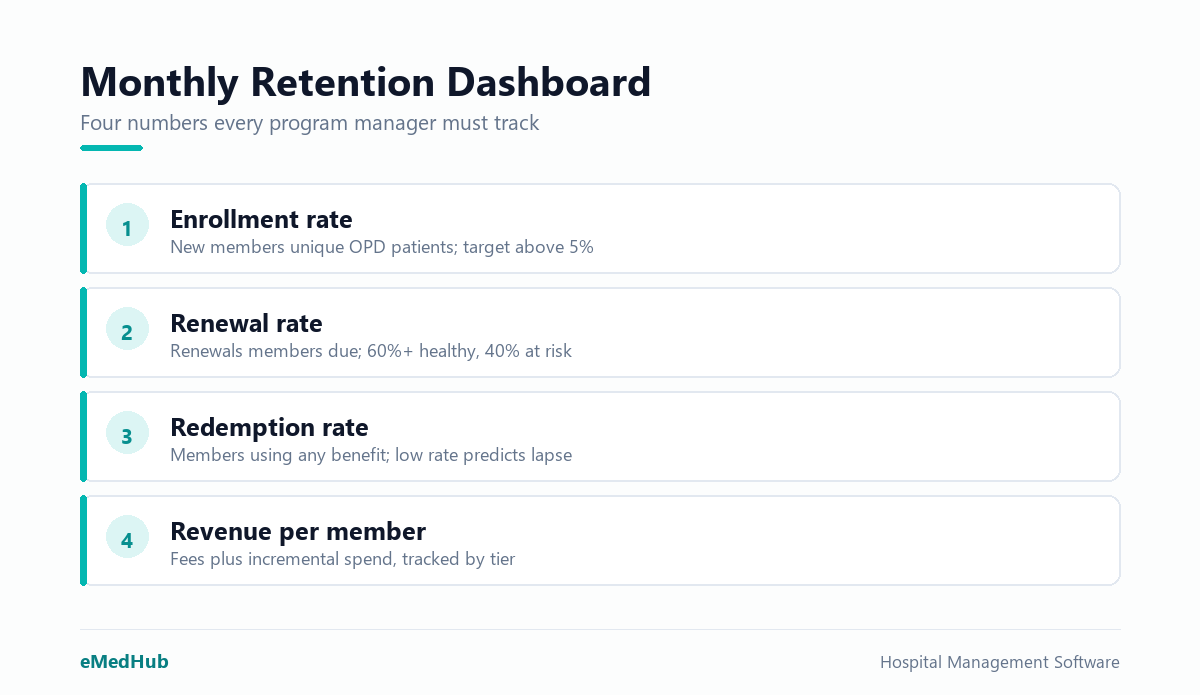
- Enrollment rate: New members enrolled divided by unique patients registered that month. Below 5% usually means front-desk staff are not actively offering the program at registration.
- Renewal rate: Members who renewed divided by total members due for renewal. Above 60% is healthy. Below 40% means benefits are not resonating with your patient base.
- Redemption rate: Members who used at least one benefit divided by all active members. A member who never redeems is a lapse waiting to happen.
- Revenue per member: Total membership fees plus incremental service spend by members, divided by active member count. This tells you whether members visit and spend more than non-members.
- Lapse rate: Memberships that expired without renewal divided by those due for renewal. Track by tier separately to identify which package is losing members fastest.
If renewal rate falls below 50%, phone a sample of lapsed members. You will usually find two root causes: benefits were never explained clearly at the front desk, or a promised benefit was not honored smoothly at the counter. Both are operational fixes, not product design problems.
How eMedHub Handles Membership Billing
eMedHub's billing module includes a built-in membership and loyalty engine. Configure your tiers, set benefit rules, and define renewal periods once. At every registration, the system checks membership status and applies the correct discount automatically. Renewal reminders go out via SMS and WhatsApp on schedule. Finance teams get a complete GST-compliant receipt trail; front-desk staff see a clear membership status banner on the patient screen. Explore the full capability in the hospital information system overview.
Ready to turn walk-in patients into loyal, recurring revenue? Book a demo and we will walk you through a live membership billing workflow.
Frequently asked questions
How do I price a hospital membership program without losing money?
Calculate the cost of each benefit: the discount impact on consultations, pharmacy margin reduction, and the cost of free health checks. Your membership fee should recover those costs with at least a 20 to 30 per cent buffer. Pilot the program with 100 patients over three months before rolling it out hospital-wide.
Is GST applicable on hospital membership fees in India?
Yes, hospital membership or wellness subscription fees are generally treated as taxable services under GST. Pure healthcare services by a clinical establishment are exempt, but packaged loyalty or membership programs typically attract GST. Confirm the applicable SAC code and tax rate with your chartered accountant before you launch the program.
Can a hospital membership program run alongside CGHS or Ayushman Bharat patients?
Yes, but keep the programs clearly separate. CGHS and Ayushman Bharat reimbursement rates are fixed by the respective authorities and cannot be further discounted through a membership card. Membership benefits apply only to self-pay consultations. Communicate this boundary clearly during enrollment to avoid disputes at the billing counter.
What is a good renewal rate for a healthcare membership program?
A renewal rate above 60 per cent indicates patients find the program genuinely useful. Between 40 and 60 per cent suggests the benefits are adequate but the experience needs work. Below 40 per cent typically points to poor benefit communication at the front desk or core benefits that patients forgot were available to them.
How does a hospital track member benefits at the point of billing?
The registration module should display membership status, tier, expiry date, and available benefits on the patient screen. When a consultation, procedure, or pharmacy bill is raised, the system auto-applies the correct discount and logs the redemption. This prevents manual errors, ensures accurate MIS data, and stops staff from honoring discounts on expired cards.