Ask any hospital CFO where margin quietly disappears and, sooner or later, the conversation lands on discounts. Not the big, negotiated corporate rates — the small, discretionary write-offs given at the counter: a "goodwill" waiver here, a rounded-down bill there, a concession approved verbally and never recorded. Individually they look trivial. Across thousands of bills a month, they add up to one of the largest and least-visible leaks in a hospital's revenue. The fix is a control borrowed from banking: maker-checker hospital billing.
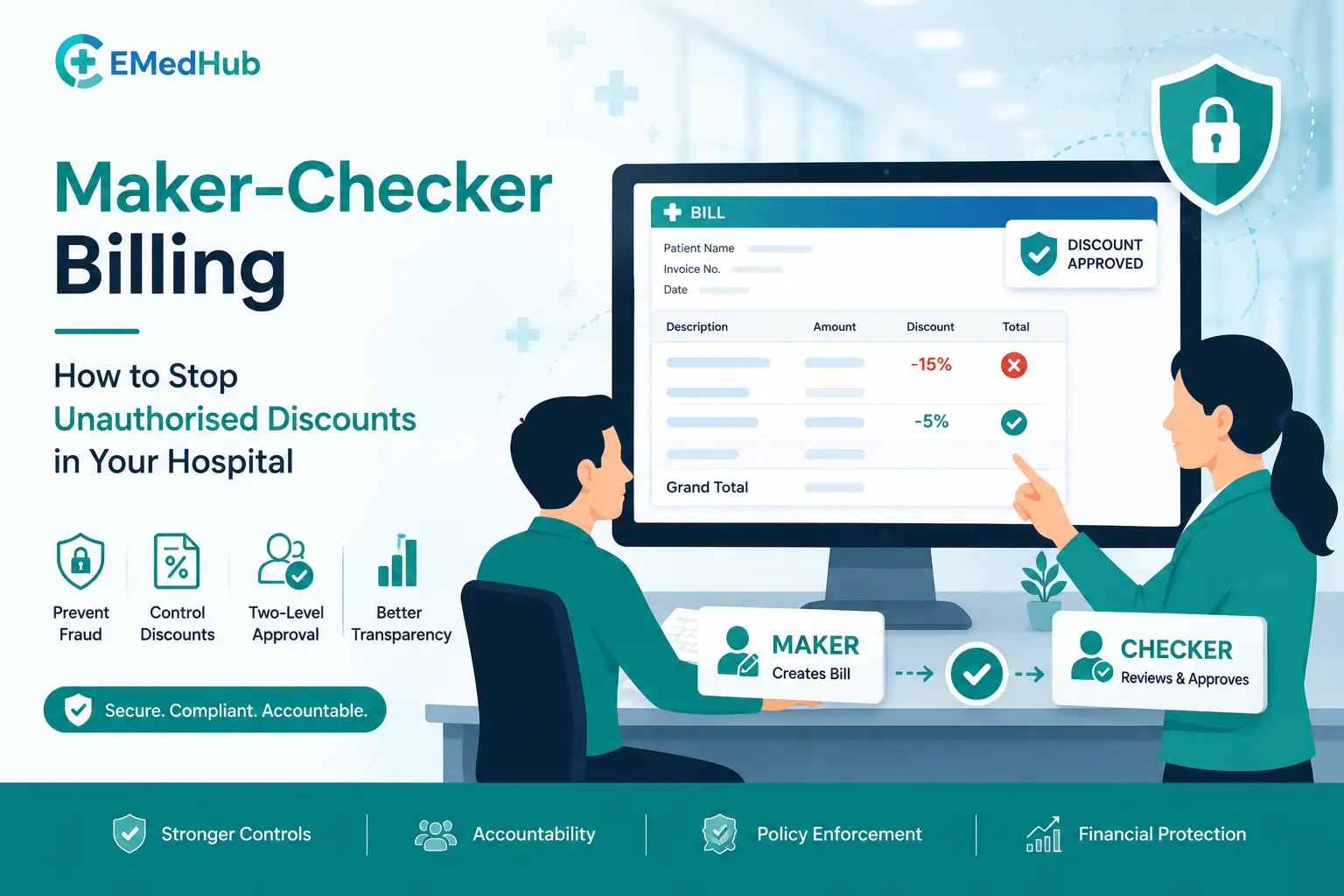
How do you control discounts in hospital billing? You separate the person who requests a discount from the person who approves it. In a maker-checker discount approval workflow, one user (the maker) requests any discount above a set threshold with a reason; a second, authorised user (the checker) reviews and approves or rejects it before it is applied. Every concession is then logged with an amount, a reason, an approver and a timestamp. Hospitals that switch this on typically see total discounts fall within the first month — not because staff become stricter, but because every waiver is finally visible.
What is maker-checker?
Maker-checker (also called four-eyes) is a control principle from banking and finance: no single person can both create and authorise a sensitive transaction. The "maker" initiates it; the "checker" independently verifies and approves it. It exists because concentration of authority is where errors and misuse happen — and because an action reviewed by a second person is far harder to fake or fudge.
Applied to hospital billing, maker-checker turns discounting from an individual privilege into a governed, two-step decision. A billing executive can still offer a patient relief, but above a configured limit they must request it rather than simply grant it. That single change — request instead of grant — is what closes the gap.
Discount leakage: the silent margin killer
Discretionary discounts leak revenue in ways that rarely show up on a standard report. Uncontrolled discounting looks like this in practice:
- No ceiling. A counter user can waive 5%, 15% or "just round it off" with nothing stopping them.
- No reason captured. The bill shows a lower figure, but not why — so nobody can tell a justified concession from a careless one.
- No approver. The decision sits with whoever happened to be at the desk, regardless of authority.
- No trail. By month-end, the discounts are baked into the numbers and impossible to unpick.
Because a discount is a legitimate-looking transaction, it never trips a fraud check or a denial. It simply lowers realisation per patient, quietly, forever. This is why discount control belongs alongside charge capture and day-end reconciliation as one of the core billing controls every hospital needs — and why fixing it is one of the highest-return, lowest-effort revenue projects available.
The maker-checker discount approval workflow
A well-designed discount approval workflow is simple to operate and hard to bypass. Here is how it works, step by step:
- Set thresholds. Configure discount limits by role, department, or bill type — for example, front-desk users up to 5%, managers up to 15%, and anything higher escalated. Small, routine concessions can auto-approve; only meaningful ones require a checker.
- Maker requests. When a user applies a discount above their limit, the system blocks it from taking effect and instead raises a request, forcing the user to select or type a reason (financial hardship, service delay, corporate courtesy, etc.).
- Checker reviews. An authorised approver sees the pending request — patient, bill, amount, percentage and reason — and approves, rejects, or sends it back with a note.
- Applied on approval only. The discount posts to the bill only after approval. Until then, the full amount stands.
- Logged automatically. Every request and decision is recorded with user, amount, reason, approver and timestamp — no separate register to maintain.
The result is that discretion still exists where it should, but authority now matches accountability. Staff aren't slowed on routine bills, and leadership finally sees the true discount picture in real time rather than at the annual audit.
The audit trail: every concession accountable
The quiet superpower of maker-checker is the audit trail it produces as a by-product. Because every discount above the threshold carries a reason, an approver and a timestamp, you can answer questions that were previously unanswerable: Which departments discount the most? Which reasons dominate? Are certain shifts or users outliers? Is a particular corporate relationship consuming margin no one signed off on?
That visibility changes behaviour on its own. When people know a concession will be reviewed and attributed to them, the reflexive "just round it off" habit fades. Combined with approval-gated bill edits and cancellations, the discount audit trail also protects the hospital in disputes and internal reviews — you can always show exactly who approved what, and why.
The NABH angle: governance you can demonstrate
Beyond the financial win, maker-checker maps neatly onto accreditation expectations. NABH standards emphasise documented processes, defined authority, and auditable records across hospital operations, including billing and finance. A discount approval workflow with role-based limits and a complete audit trail is exactly the kind of documented, demonstrable control surveyors look for. Instead of a policy that exists only on paper, you have a system that enforces the policy on every bill and keeps the evidence automatically — turning a compliance requirement into an operational habit.
How eMedHub builds maker-checker into billing
In eMedHub's Hospital Information System, maker-checker discount control is built into the billing engine rather than bolted on. You configure discount thresholds by role and department; any discount above the limit is held as a request until an authorised checker approves it; and every concession is logged with its reason, approver and timestamp. Bill edits, cancellations and reverts run through their own approval-gated workflows with the same full audit history, and role-based access ensures only the right users can touch pricing at all. The effect is consistent across OPD, IPD, pharmacy and diagnostics — one governance model, everywhere money changes hands. Hospitals that turn it on routinely report a visible drop in total discounts within the first billing cycle, purely from making every waiver accountable.
Frequently asked questions
How do you control discounts in hospital billing?
Separate the requester from the approver. In a maker-checker discount workflow, one user requests any discount above a set threshold with a reason, and a second authorised user approves it before it applies — with every concession logged by amount, reason, approver and time.
What is maker-checker in hospital billing?
Maker-checker is a "four-eyes" control from banking applied to billing: no single person can both create and authorise a discount. It replaces informal, unlogged waivers with a governed, auditable two-step approval.
Does maker-checker slow down the billing counter?
No. Small, routine discounts within a user's limit auto-apply; only concessions above the threshold require a checker. Routine bills are unaffected, while meaningful write-offs get a second set of eyes.
Will it actually reduce our discounts?
Typically yes — hospitals see total discounts fall within the first month. The reduction comes from visibility and accountability, not from denying legitimate concessions.
Want to see it on a real bill? Book a free demo and we'll show you how eMedHub's maker-checker discount workflow, thresholds and audit trail stop unauthorised write-offs — without slowing your counter.