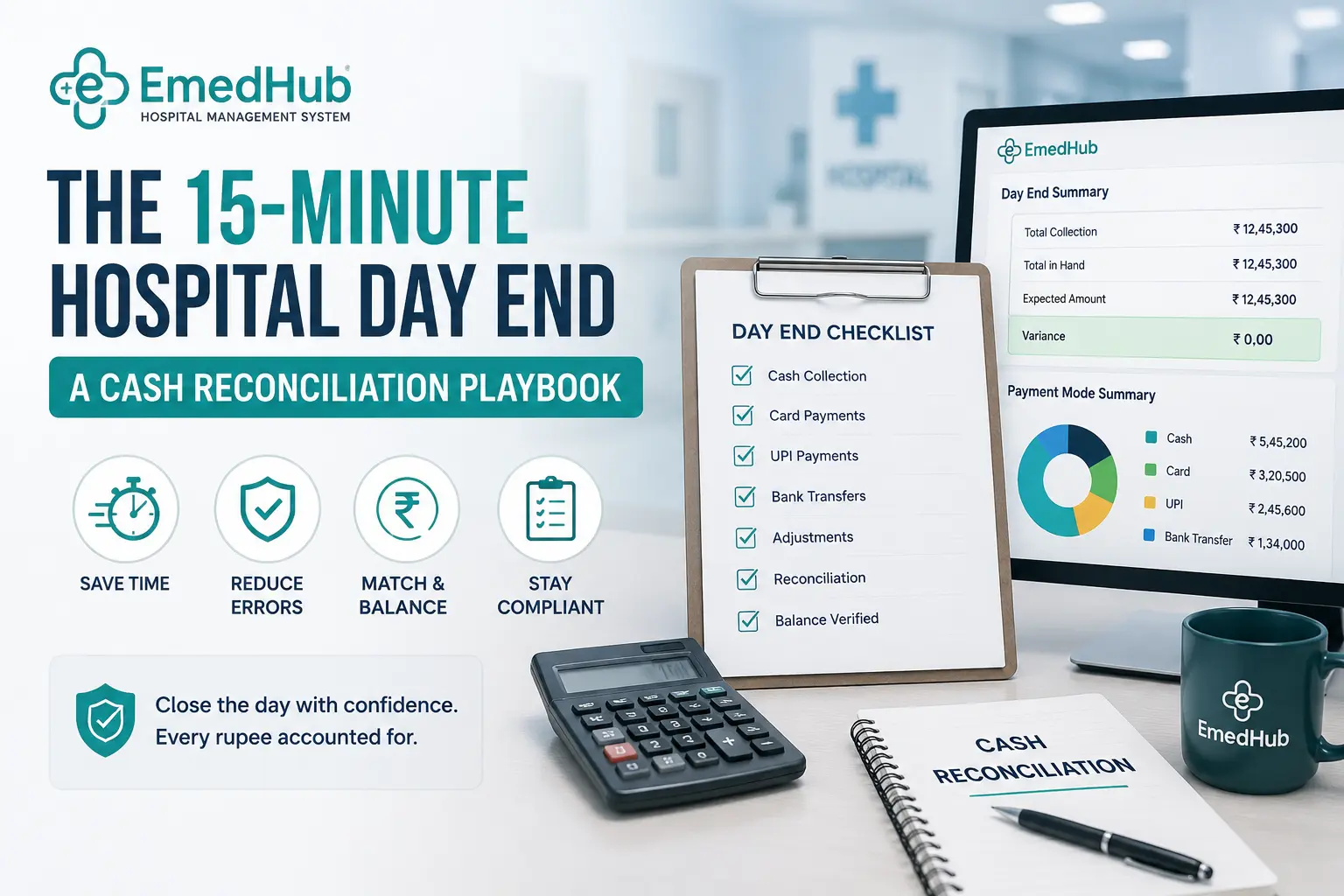
In most hospitals, the money problem isn't discovered — it's excavated. Months after the fact, an auditor finds a counter that came up short, a refund with no matching receipt, a cancelled bill that was never really cancelled. By then the cashier has moved on, the patient is long gone, and the money is unrecoverable. The single most effective fix is boring, daily, and takes about fifteen minutes: hospital day end reconciliation.
Done well, day-end closing turns billing leakage from an annual audit surprise into a routine control. This playbook lays out exactly what to reconcile, the step-by-step process, and the variances to watch — the kind of daily discipline most Indian hospitals still do on paper, if at all.
Why day-end reconciliation matters
The core principle is simple: leakage caught the same day is recoverable; leakage found months later is gone. When a mismatch surfaces at day-end, the transaction is fresh — the cashier remembers it, the receipt is on hand, the patient may still be reachable, and a correction is easy. When the same mismatch surfaces at the annual audit, it's just a number nobody can explain.
Daily reconciliation also does something an audit never can: it changes behaviour. When every counter knows its collections will be matched against services rendered before they clock out, the small habits that cause leakage — untracked concessions, "I'll enter it later," cash pocketed against a promise to bill — quietly disappear. It's the difference between policing losses and preventing them.
What to reconcile at day-end
A proper close is more than counting cash. At minimum, each day's close should reconcile:
- Cash collected vs cash recorded, per counter (the core cash counter reconciliation).
- Card, UPI and bank-transfer collections vs the gateway/POS settlement.
- Cheques received, with reference numbers.
- Refunds issued, each tied to an original receipt.
- Cancellations and bill edits made during the day, with approvals.
- Discounts and concessions granted, with reasons and approvers.
- Advances and deposits collected and adjusted.
- Services rendered (from clinical/order data) vs services billed — to catch anything delivered but never charged.
That last line is the one paper closes almost always miss, and it's where the biggest money hides: reconciling collections is table stakes; reconciling collections against what was actually done is what catches unbilled care.
How to do hospital day-end reconciliation: step by step
Here is the 15-minute close, as a repeatable sequence:
- Freeze the day. At shift/day close, stop new transactions for that cashier so the totals can't move while you reconcile.
- Pull the system total. Generate the day's collection summary per counter and per payment mode (cash, card, UPI, bank transfer, cheque).
- Count physical cash. Count the drawer and enter the actual cash figure. The system shows the variance against expected cash instantly.
- Match digital modes. Reconcile card/UPI/bank totals against the POS or gateway settlement; confirm cheque references.
- Review refunds and cancellations. Confirm every refund maps to an original receipt and every cancellation carries the required approval.
- Check discounts. Verify concessions above the threshold were approved and reasoned (your maker-checker log makes this a glance, not an investigation).
- Reconcile services vs bills. Compare services ordered/rendered against services billed to flag anything delivered but uncharged.
- Explain variances. Note a reason against any mismatch — short, deposit error, pending settlement — while it's still fresh.
- Lock and hand over. Close the counter, generate the day-end report, and hand cash and report to the next custodian or the safe.
- Escalate the exceptions. Route unresolved variances above a limit to a supervisor the same day, not the same year.
On a system that does the arithmetic for you, this is a fifteen-minute routine per counter. On paper, it's an hour and it still misses the services-vs-bills check.
Common variances (and what they usually mean)
Most day-end mismatches fall into a handful of recurring patterns:
- Cash short — miscount, wrong change, or a collection taken without a receipt. Recount first; if it persists, it's a receipt-discipline issue.
- Cash over — a receipt raised for less than the cash taken, or a missed entry. Over is not "good"; it signals the records are wrong.
- Digital mismatch — timing (settlement lands next day) or a failed/duplicated transaction. Match against the gateway, not memory.
- Refund without origin — a refund not linked to a receipt. A classic leakage and fraud vector; require the original.
- Cancelled-but-collected — a bill cancelled after cash was taken. Should be impossible without approval.
- Unbilled services — care delivered that never became a charge. The largest and quietest leak of all.
Logged daily with reasons, these variances become a management report: which counters, which shifts, which patterns — so you fix causes, not just symptoms.
From paper to automation
The reason day-end fails in so many hospitals isn't unwillingness — it's that a manual close is slow, error-prone, and can't reconcile services against bills at all. Automation flips that. In eMedHub's Hospital Information System, day-end closing is a structured, built-in step: the system computes expected collections per counter and payment mode, shows cash variance the moment you enter the drawer count, ties every refund to its receipt, and surfaces cancellations, edits and discounts with their approvals and audit trail. Because billing, pharmacy, lab and services all post to the same ledger, the close can also flag services rendered but not billed — the check paper can't do. The daily report is generated automatically and retained for audit, so what used to be an annual reconstruction becomes a same-day, self-correcting control.
Your embeddable day-end checklist
Print this and tape it to every cash counter:
- Freeze the counter / stop new transactions
- Pull system collection total (per mode)
- Count physical cash → enter actual → read variance
- Match card / UPI / bank / cheque to settlement
- Verify every refund has an original receipt
- Confirm cancellations & edits are approved
- Check discounts are reasoned & approved
- Reconcile services rendered vs billed
- Write a reason against every variance
- Lock counter, generate report, hand over cash
Frequently asked questions
How do you do hospital day-end reconciliation?
Freeze the counter, pull the system collection total by payment mode, count physical cash and read the variance, match digital and cheque collections to settlements, verify refunds and cancellations are approved, reconcile services rendered against services billed, note a reason for every variance, then lock the counter and generate the day-end report — ideally the same day.
What is cash counter reconciliation in a hospital?
It's matching the cash and digital payments a counter recorded against what it actually collected, per shift or day, so shortages, overs and unrecorded transactions are caught immediately rather than at audit.
How long should day-end closing take?
On an automated system, about 15 minutes per counter, because the software computes expected totals and variances instantly. Manual, paper-based closing takes far longer and still can't reconcile services against bills.
Why reconcile daily instead of monthly?
Because leakage caught the same day is recoverable and explainable, while the same mismatch found weeks or months later is usually unrecoverable — and daily accountability prevents the habits that cause leakage in the first place.
Want a 15-minute close in your hospital? Book a free demo and we'll show you how eMedHub's day-end reconciliation catches cash, card, refund and unbilled-service variances the same day — with the report generated for you.